 david coombe | history
SUMMARY: This project importantly attributes to S.T. Gill works which have previously been attributed to George French Angas. This article examines Gill's work for and relationship with Angas, 1844 to 1852. Gill is best Angas!
Article type: OVERVIEW & REFLECTION
In this article ...
This project importantly attributes to S.T. Gill works which have previously been attributed to George French Angas.
These attributions are made in several analytical articles, beginning (in November 2020) with Port Adelaide and concluding (January 2026) with the Victorian diggings. This page is an overview tieing those articles together. All articles are referenced in the body of this article (usually indicated → to a boxed panel), but for reference, the articles (in chronological order of publication) are:
The value of these conclusions is in giving due credit to Gill for some of his best work – credit previously taken by and given to Angas.
Works listed here (below) include the most significant ones I have (re)attributed to Gill. (They are repeated here for ease of reading even though they're catalogued on other pages.)
It's easy to understand how, in the past, works by Gill have been attributed to Angas, as that's what Angas himself intended. Angas claimed the works of others as his own in his 1846 Egyptian Hall Exhibition in London, in his sixty plates of "South Australia Illustrated" and elsewhere. →

George French Angas in London and S.T. Gill
Some of Gill's pictures were used by George French Angas in London in 1846-1847: in his Egyptian Hall exhibition and his books South Australia Illustrated and Savage Life and Scenes.
In the past works have been attributed to George French Angas based on:
Normally it would be thought these three criteria make for a sound attribution. But with Angas knowingly taking credit for the work of others, these are not sufficient criteria.
One work which meets the three criteria is Klemzig village, inherited by descendants and claimed by Angas as his own work in Plate 12 of "South Australia Illustrated". And yet, I show it is not by Angas. →
Klemzig, Angas, a German Hay Wagon and Chickens
Analysis of a pencil sketch of the German village of Klemzig. A comparison of the Klemzig pictures of F.R. Nixon, George French Angas and S.T. Gill.
I re-attribute the sketch from Angas to Gill. It contains a Gill device in the chickens and rooster. And Gill has indicated to Angas where to add his hay cart staffage. I counter Jones' argument that Nixon copied Angas.
It needs to be emphasised that Angas family provenance is no guarantee of Angas authorship, with some works having been later purchased by family. An example where family has attributed a Gill to their artist relative is North Terrace looking east and Trinity Church | AGSA 0.628.
Past attributions were embedded into Australian colonial art history by Angas author Tregenza (1982) and were unchallenged by Gill author Appleyard (1986). More recently Jones (2021) continued with these. Consequently and understandably, they were also generally accepted by Art Gallery of South Australia (e.g., catalogue, Hylton 2012) and National Library of Australia (Angas Collection).
Neither Tregenza nor Appleyard addressed the Gill work Port Adelaide seen from the north-west across the Reach | NLA NK208, perhaps unsure how to position it. This is the view of Port Adelaide used by Angas, without acknowledging Gill, for his South Australia Illustrated. Appleyard (p. 68-69) included other versions of this view (SLNSW-ML, AGSA) but still didn't link them with Angas' plate. Early in the project I analysed the various views. →
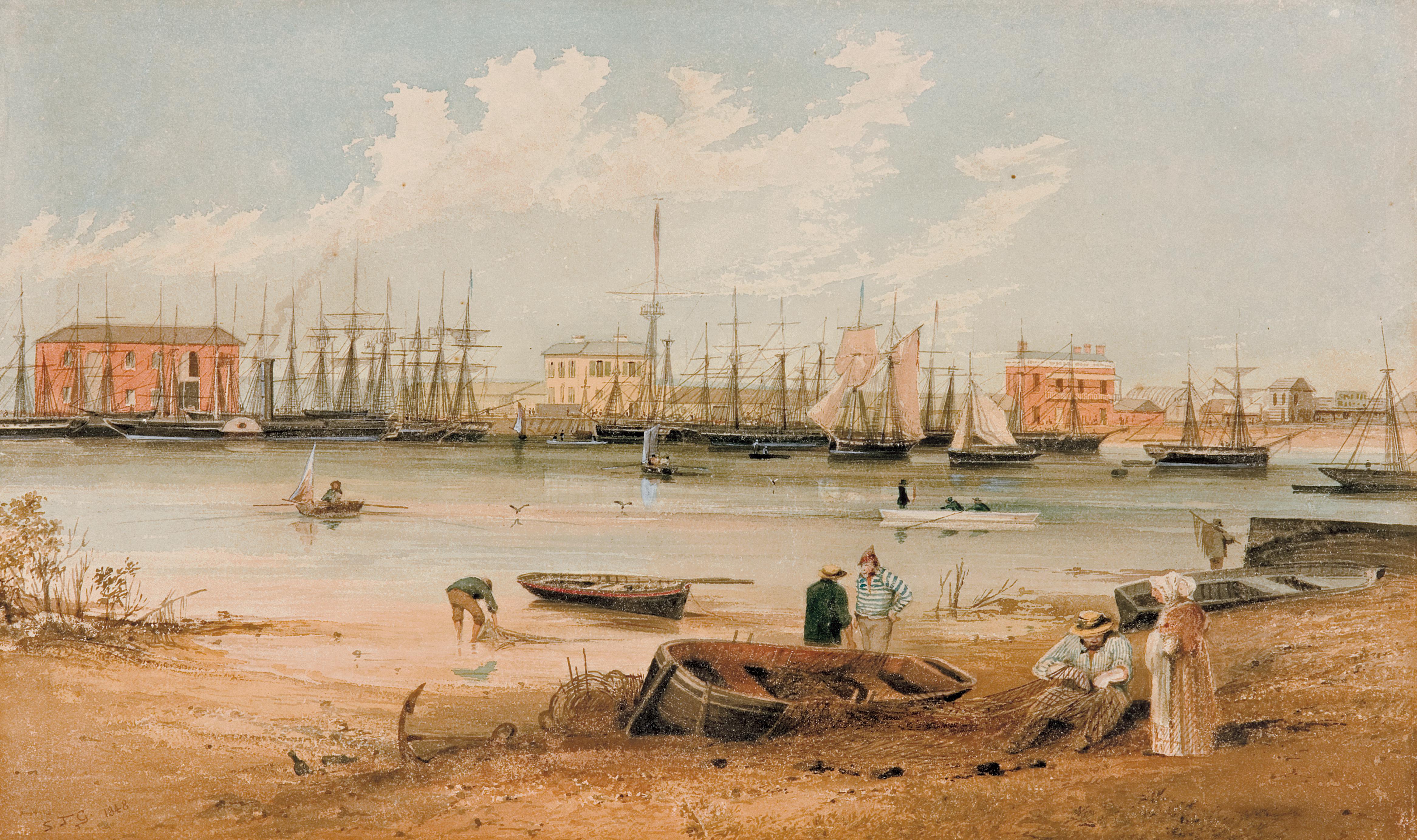
S.T. Gill's Port Adelaide
Who painted 'Port Adelaide', plate 7 in 'South Australia Illustrated' – George French Angas or Samuel Thomas Gill? I resolve this question with the help of a place and time machine – an interactive map of 1840s Port Adelaide views.
Concerns over Angas' authorship have been expressed in the past.
McCulloch (1977 on goldfields) doubted the Victorian diggings views were by Angas.
Tregenza (1982 on Angas, pp.17-18) acknowledged Angas used Gill's Native tomb, Myponga | SAM AA8/4/1 and misappropriated works by Rodius. Appleyard (1986 on Gill) rarely mentioned Angas, but noted his use of Gill's Native tomb, Myponga | SAM AA8/4/1.
After decades being attributed to Gill, SAM's Native tomb was reattributed to Angas by Jones (2021 on Angas). I previously wrote that Jones' argument was flawed in S.T. Gill and George French Angas, 1844-1845 | Jones (2021) on Gill & Angas and S.T. Gill - Subject - Native Sepulchre.
Concerns were also voiced in Visions of Adelaide : 1836-1886 (2005). Tracey Lock-Weir wrote knowingly: "Angas exploited his influence over others, particularly Cawthorne, who was anxious to rise on his recommendation. In his short time in Adelaide Angas earned a public enemy in the artist, F. R. Nixon, who wrote a scathing review of his solo exhibition held at the Legislative Council Chambers in Adelaide in 1845. Angas appears to be unconscionable about collaboration or plagiarism and there was certainly a healthy exchange of ideas between Angas and the colony's leading artist, S. T. Gill, with whom he was 'slightly acquainted'." (p 88)
Grishin (2015 on Gill) made only passing mention of Angas.
Jones specifically addressed Angas' copying (Whose originals?, pp. 105-109). Jones defended Angas' character by noting other artists copied or reproduced without acknowledgement.
Jones stated Angas made his own versions of two James Henderson pictures for his London exhibition: Crater of an Extinct Volcano and Lake Torrens, Sunset during a Sirocco. However no such Angas Crater is extant and this exhibit is well explained by Gill's Extinct Crater, North of Spencer Gulf, South Australia | AGSA 0.614, which has Angas-Johnson family provenance. The sunset picture, Scene showing emus in a plain | AGSA 721HP4, I reattribute from Angas to Gill. It also has Angas/Johnson family provenance.
Altogether I identify a dozen Gill works in Angas' April 1846 | Egyptian Hall Exhibition. This is no mean contribution by Gill.
With two of them 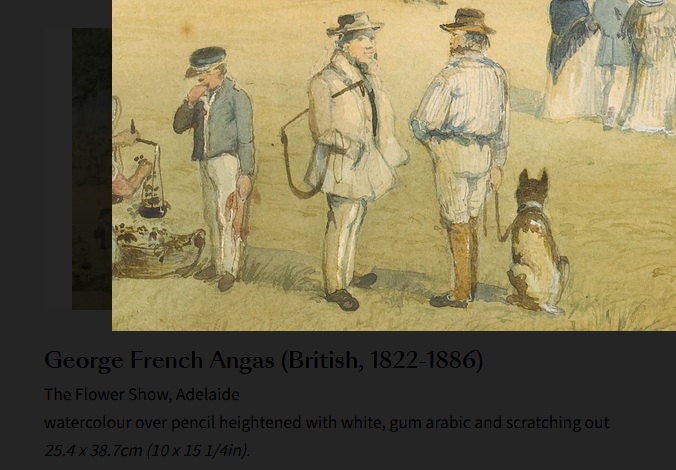 it appears Angas trimmed the left edges of the pictures to remove Gill's signature for the exhibition.
Jones noted Alexander Tolmer's complaint against Angas in his 1882 memoir, and assessed the Rodius copying was "the most egregious example" of Angas not crediting authorship.
Jones (p.196) casually commented, "Angas could justly claim to be the first professional artist to work in South Australia", but gave no explanation. However he has neglected both Gill and E. A. Opie in 1840. I examined Opie and Gill, their public launches, and considered the economic factors affecting the 1840s artists and ultimately the coming of Angas himself → S.T. Gill - Narrative, 1843 to 1844.
Jones repeatedly characterised Angas' use of Gill as "borrowing", even using this word for the book's Gill index entry. It reads like "good character" defence.
In this project I conclude it was less Angas borrowing than it was Gill ghost painting (and some Angas stealing). But rather than give further space to moral judgement, we could attend to giving appropriate artistic credit to Gill based on the evidence.
With Angas using Gill's material, what was the nature of their relationship?
To what extent was the relationship generally known at the time?
It's clear that Gill was engaged in the wider (George Fife) Angas project in late 1844 while George French was visiting New Zealand. →

S.T. Gill at Angas' Barossa 1844
S. T. Gill was in the Barossa sketching for the Angas family from 29 October to 4 November 1844. I identify some works as well as influences on Angas publications: "South Australia Illustrated" and "Barossa Range and its neighbourhood".
With George French's return, Gill made a major contribution to his 60 plate South Australia Illustrated project. →
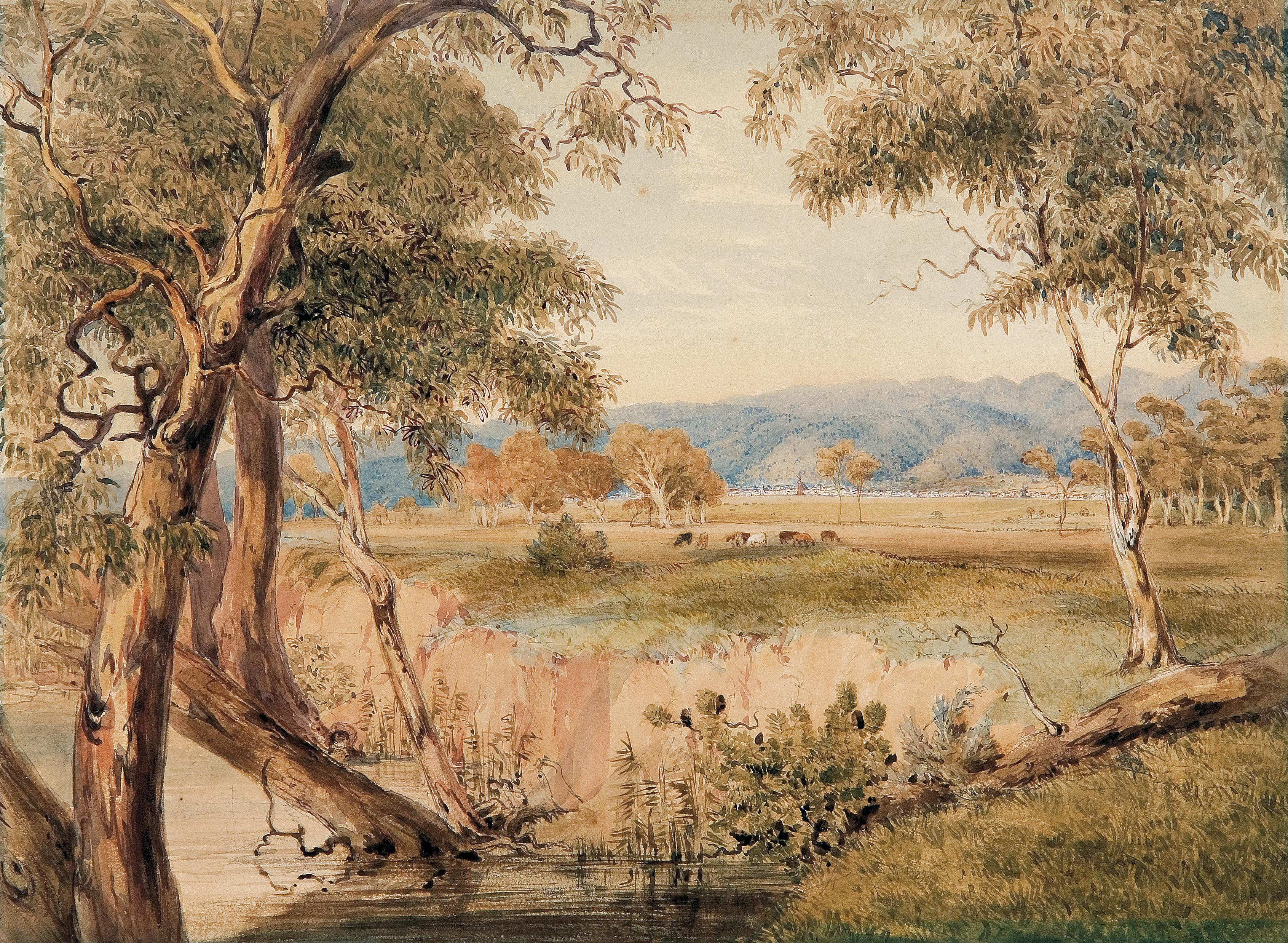
S.T. Gill and George French Angas, 1844-1845
1844-45. George French Angas made a splash in South Australia in two visits (interrupted by a trip to New Zealand). He left on 2 July 1845, a fortnight after his art exhibition and its associated controversy.
It would seem Gill's main role was in landscape, with Angas focussing on Aboriginal people and material culture, though that largely with the help of W. A. Cawthorne. In his diary, Cawthorne relates his introduction to Angas' project.
Yesterday I strolled about for one hour and walked into my former august Master Anthony Forster Esq. He told me that as soon as his imperial highness George French Angas author of a "Tour through Malta & Sicily" &c &c &c &c he should condescend so low as to introduce me to his Majesty for the ostensible purpose of "telling him all I know about the Natives for his intended work". So you see to what an immense height my talents have raised me – see the unparalleled distinction that is awaiting me. Observe the remunerating employment I shall be engaged in but for all this I would rather press real talents of gold or silver than to all the intellectual ones that his august majesty can command. (Cawthorne and Angas | 1844)
Through the sarcasm, we see here too the social class divide between Cawthorne and Angas. →
S.T. Gill and W.A. Cawthorne
WA Cawthorne (1824-1897): school teacher, amateur artist, documenter of Aboriginal culture. George French Angas' 'South Australia Illustrated'. The relationship with Gill, his art master from February 1845.
It's clear from several diary entries that Cawthorne hoped for some income from Angas's project.
However we know nothing of Gill's expectations. Was he paid up front for some work? Was he promised proceeds from the sale of Angas' publications? To what extent did he agree to let Angas take credit for authorship?
I've found no evidence that an arrangement between Angas and Gill was public knowledge. Even Cawthorne in his extensive diaries doesn't mention an Angas-Gill relationship, nor mentions the pair in the same room (!) (as far as I can find).
However I suspect F. R. Nixon – who was likely a friend of Gill – had at least an inkling of an arrangement – though he doesn't explicitly say so in his "bombshell" letter of 17 June 1845. He wrote to the newspaper, straight after seeing Gill hard and fast at work be(for)e Angas' Adelaide exhibition. Nixon was more than annoyed by Angas. → S.T. Gill and George French Angas, 1844-1845 | Nixon's Letter.
In the Adelaide exhibition several works were omitted at late notice. I argue these were likely Gill works and their exhibition may have caused questions to be asked, not least by those who may have seen Gill working in his studio. → S.T. Gill and George French Angas, 1844-1845 | June 1845.
I suspect Register newspaper proprieter James Allen – S.T. Gill and George French Angas, 1844-1845 | Further Review – had an idea of what was going on. Telling is his surprise that Angas could create so much work in so short a time! Another subtlety is Allen's reference to his own copy of another artist's (read "Gill") Native tomb, Myponga | SAM AA8/4/1.
What was in the Angas arrangement for Gill? It's unlikely it was all for recognition. Plates with Gill's name in South Australia Illustrated may have contributed to his reputation – but there were only two published (though Angas had other signed works). Gill also produced unsigned work for which presumably Angas could take credit. One would think Gill expected to be remunerated.
(I earlier summarised Gill's work for Angas in 1844-1845.)
Jones writes: "The fact that Gill made no public complaint about the appearance of his images in South Australia Illustrated raises the possibility that Angas had negotiated this use with Gill in Adelaide. It is even possible that he had commissioned the works or had purchased the right to use them. This would explain Gill's silence (and that of Joseph Jenner Merrett and even of Charles Rodius) on this matter. However these images were acquired, Angas certainly relied upon Gill for the shortfall in his Adelaide street and architectural views." (p 283)
There probably was an agreement, but we don't know how far it may have extended. As to complaint, absence of evidence is not evidence of absence. Complaint aside, we'd do well to consider the contrast in social class and standing between the two. Angas had arrived in South Australia with the Queen mother as patron and full facilitation of the governor and his father's enterprise. What benefit would anyone gain by complaint? Tolmer waited until 1882! The apparent absence of complaint by Merrett and the former convict Rodius doesn't tell us much. Jones (107) also referred to the Rodius copying as "egregious".
Whatever happened in 1844-1846, it seems Gill was prepared to go yet another round with Angas. But it was a very quick round.
From the Victorian diggings, Angas only gleaned three images – I argue these came from Gill. Angas added "staffage" to two pencil sketches for an output of two basic lithographs in Sydney. The third pencil sketch, which he sent to his London publisher, wasn't published.
It's easy to imagine Gill producing three pencil sketches for Angas when the latter briefly visited in Melbourne in 1852. →
George French Angas - Victorian Diggings, 1852
The weight of evidence is against Angas' presence at the Victorian diggings. He visited Gill in Melbourne in August 1852 and again used Gill's pictures for his own publication. This further cements the role of Gill as a ghost artist for Angas.
What about the Angas authors on the 1852 scenes? Tregenza (p 23) mentioned just Angas' correspondence on the 1852 Victorian diggings pictures without actually illustrating them. Although outside his book's scope, Jones doesn't mention the Victorian content in a brief biographical outline (p 331) of Angas' Sydney period.
The idea of Gill as a ghost artist is not an altogether strange one.
Sasha Grishin pioneered the story of Gill as ghost artist in his 1993 book Dr. Doyle's sketches in Australia. That series of works dates to 1863.
E.L. Montefiore is another who was credited with Gill's works, perhaps by mutual intent, Frome Bridge being one of these.
In this project I cross-referenced pictures in Angas' publications, exhibitions and sales with possible source works and analysed stylistic detail and artistic devices.
When Gill works were misattributed to Angas, what became of Angas' style? How could one distinguish the two artists based on style?
This problem came to great attention in the Bonhams 2011 auction of two works with French Angas provenance. (The following two links are just to the List of Works below and you may prefer to just continue reading.)
Jones (2021) wrote that the Bonhams works were Angas' copies of Gill. I countered Jones' argument. → S.T. Gill and George French Angas, 1844-1845 | Jones (2021) on Gill & Angas. Further, when it comes to these two watercolours, it appears Angas trimmed the left edge to remove Gill's signature for his London exhibition. → George French Angas in London and S.T. Gill | Update 2026-02-13.
So how does one now distinguish a Gill from an Angas?
Aspects that may appear at first trivial become important:
The Mount Gambier article allows a style comparison of Angas and Gill works of the same subject. Although Gill's Mount Gambier was likely based on sketching by another artist, we can see here the difference in style between Angas and Gill. →

S.T. Gill - Subject - Mount Gambier
The Mount Gambier pictures attributed to S.T. Gill and George French Angas. I re-attribute the 'Blue Lake' watercolour from Angas to Gill.
Best Angas? Works held up as some of Angas' best have turned out to be Gill's.
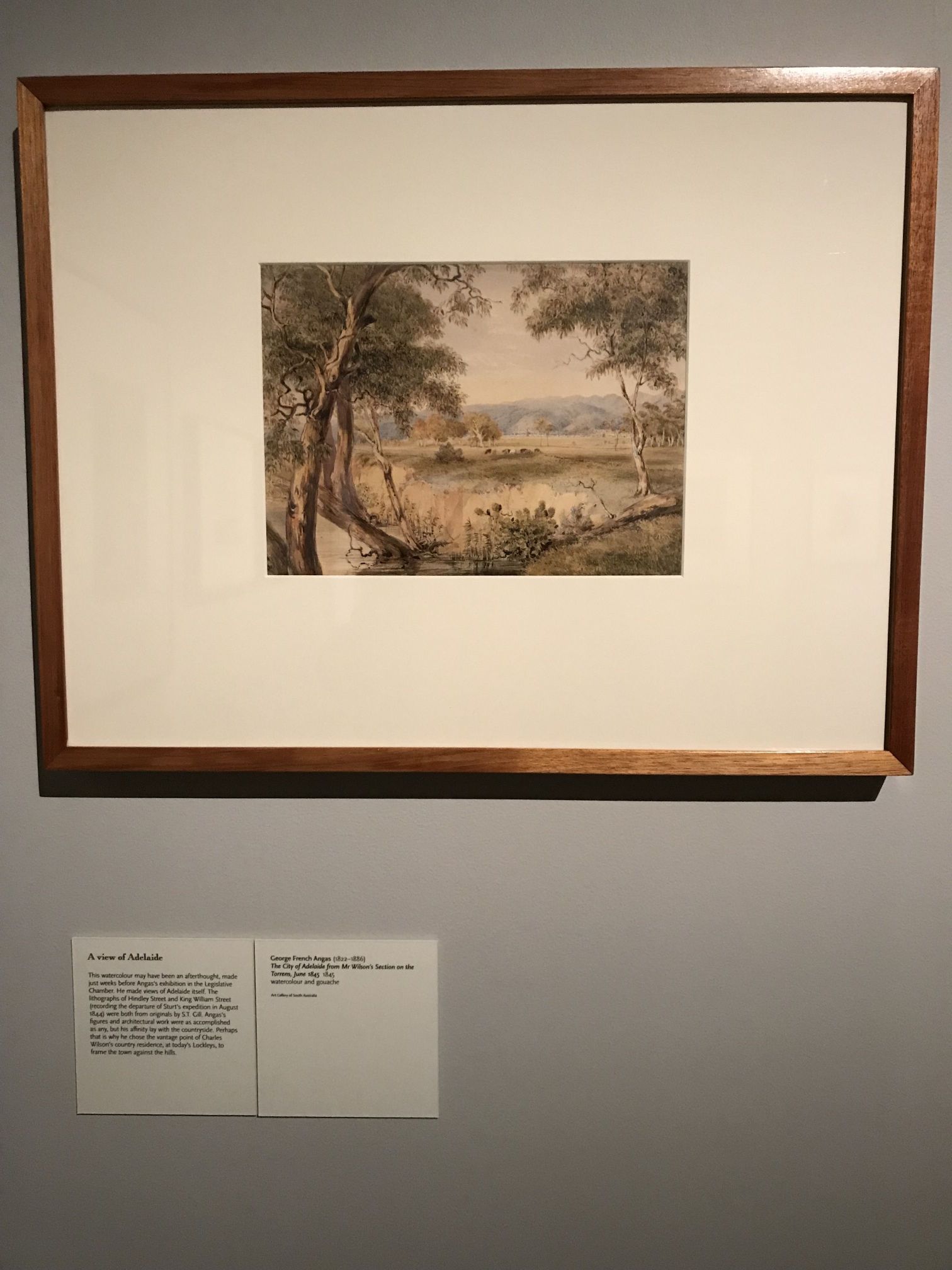 The City of Adelaide from Mr. Wilson's Section on the Torrens, June 1845 | AGSA 721HP1
Hanging in the 2021 exhibition Illustrating the Antipodes: George French Angas at the National Library of Australia. (Author photo) (Click image or link to zoom.)
Works listed here are the most significant ones in the Angas-Gill relationship. (They are catalogued on other pages.) Those I have reattributed to Gill are (generally) identified by Artist: Gill, S.T. (attr.).
To see these works, with accompanying notes, just scroll down or jump to the List of Works.
Scroll down to see all pictures along with detailed notes or click a link to jump to a specific work from the list.
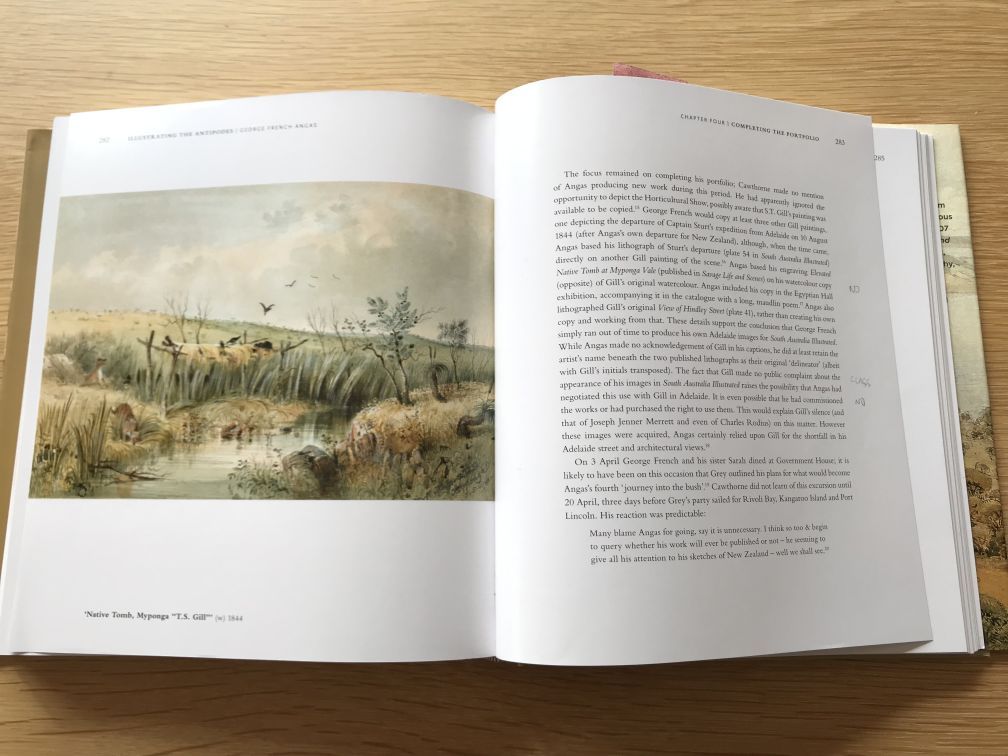 Native tomb, Myponga | South Australian Museum AA8/4/1
Artist: Gill, S.T. | Date: 1844-05~ | Appleyard cat. 39 | 18.5(H) x 28.5(W) cm
Catalogue: S.T. Gill and George French Angas, 1844-1845
The scene is an Aboriginal elevated mortuary platform near a stream, with birds descending and a pair of dingoes below. Sparsely treed hills are in the background. Grass tree and honeysuckle are represented.
I shall refer to this as the Angas/SA Museum picture. Gill painted two almost identical watercolours of this scene, the other being the Eyre/RCS picture for E.J. Eyre. One would think they were likely executed within days of each other, likely in May 1844.
George French Angas reproduced this as plate 2 in his "Savage Life and Scenes", published in November 1846. George French Angas' 1846 London exhibition included a work of a similar description: No. 209 "Elevated Native Tomb at Myponga" which is likely this work. Note the stick in the water (foreground left) and dingo sitting up (left).
Reverse inscription: Native Sepulchre near Myponga Plains by T.S. Gill, 1844. Front inscription (lower right): Native Tomb / Myponga / T.S. Gill. Provenance: J. Angas Johnson (whose collection was both by Angas family inheritance and by purchase).
For more detail see the catalogue / main entry.
207
A native corroboree at night | National Library of Australia NK2124
Artist: Gill, S.T. | Date: 1844 | Appleyard cat. 37 | 42.7(H) x 63.5(W) cm
Catalogue: S.T. Gill and George French Angas, 1844-1845
An Aboriginal corroboree around a fire on a full moon; sparsely treed hills in the background; men dance with spears and wirris; spectators seated at left provide accompaniment. Three main characters at right watch the corroboree: an aboriginal man standing with long spear and two white men behind him, one standing with curly hair and fat tummy, the other mounted on a horse.
This is a very large watercolour. Although extremely difficult to see in its dark background, the picture is signed lower left "STG ..." (possibly but not confidently "Nov/44") in black. Given the approximate date and the men's appearance we have a reasonable chance of identifying them. They are likely to be (left to right): Kadlitpinna (Captain Jack), George French Angas, W.A. Cawthorne.
"Mr Angas I should say was about two and twenty, perhaps less – small of stature about 5ft 6in at the most – thickish set in the body ..." (Cawthorne, page before 3 Feb 1844)
"I am going to take Capt Jack (one of the Aborigines is called) up to Mr Angas in full dress as a warrior – oiled – painted – decorated &c. &c. precisely as they dress themselves when a fight takes place – to be drawn." (Cawthorne, 3 Feb 1844)
"This evening I went down to the natives with Mr Angas and Fooks to see the "Cure Palti" performed again. Mr A. took a sketch of them and I have to describe it." (Cawthorne, 3 April 1844)
For more detail see the catalogue / main entry.
41
Sturt's overland expedition leaving Adelaide 1844 | National Gallery of Australia 2012.1307
Artist: Gill, S.T. | Date: 1845-02~/1845-06~ | Appleyard cat. 80.3 | 24.8(H) x 38.4(W) cm
Catalogue: S.T. Gill and George French Angas, 1844-1845
The scene is the departure from Adelaide of Charles Sturt's Great Northern Expedition on 10 August 1844 ("side-on" view).
The cavalcade is proceeding from Grenfell Street at the right of picture and turning into and continuing north along King William Street. The view is northeast, looking from a vacant block (acre 140) diagonally across the intersection to Montefiore's store (acre 108), behind and to the right of which are the South Australian Company buldings on Rundle Street (acre 44).The building at right is Montefiore's house. (Noticably absent from this picture are Gill's street dogs.)
This "side-on" view differs from the "head-on" view of AGSA 0.644 and predates the King William Street premises (acre 79) of surgeon dentist Robert Norman built between April and July 1845.
This painting has excellent provenance from the family of George French Angas. It is very likely that Gill painted this for Angas who went on to show it in his April 1846 London exhibition as "144. Starting of Captain Sturt from Adelaide, on his Expedition into the Interior, in August 1844". Angas departed Adelaide for Sydney and London on 2 July 1845. I think this painting was painted after Angas' 22 January 1845 return to Adelaide and before completion of Norman's.
There are two top-hatted gentlemen in a two wheeled vehicle, with the near man in the grey coat probably being Governor George Grey. That being the case, the other man could be Captain O'Halloran, Grey's Private Secretary. These gentlemen also appear in AGSA 0.1128.
There are two chickens and a rooster – a device frequently used by Gill. See Klemzig, Angas, a German Hay Wagon and Chickens.
Bought in 2011 by NGA. See Bonham's auction catalogue entry with high resolution image.
It appears Angas trimmed the left edge to remove Gill's signature for his London exhibition. In AGSA 0.1128 the signature is at the bottom left edge. By contrast NGA 2012.1307 has lost some of the leftmost scene - the edge where Gill then normally signed.
For more detail see the catalogue / main entry.
Map | S. T. Gill - Adelaide
252
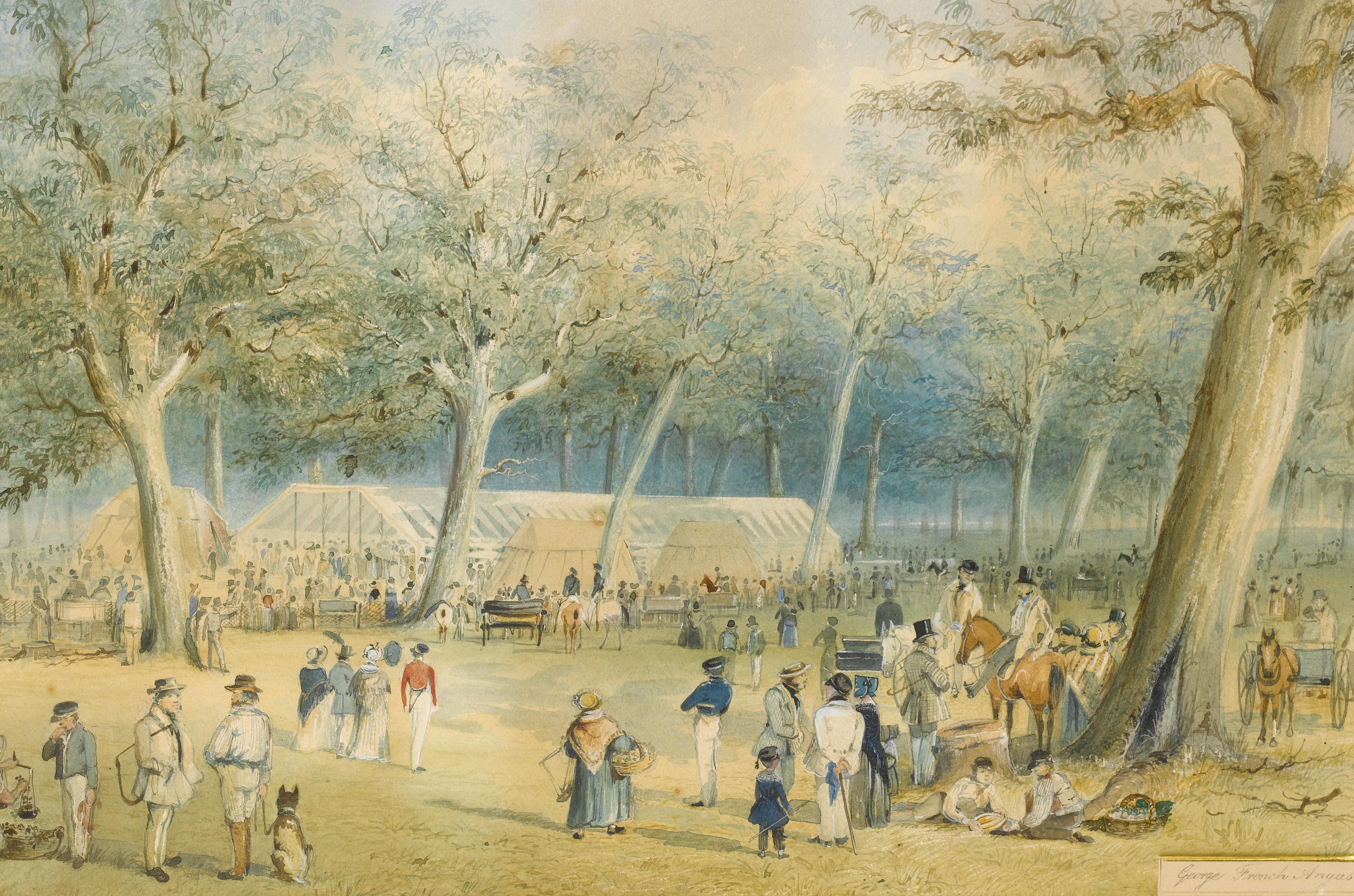 The Flower Show | National Gallery of Australia 2012.25
Artist: Gill, S.T. | Date: 1845-02~ | Appleyard cat. n/a | 25.5(H) x 38.5(W) cm
Catalogue: S.T. Gill and George French Angas, 1844-1845
The Agricultural and Horticultural Exhibition was held in Adelaide on Friday 14 February 1845 on the Park Lands to the northeast of the city. This is a rear view of the exhibition showing the carriage entrance; behind is the 120 foot long main pavillion and three smaller marquees set amongst the gum trees. In 1845, the carriage entrance was "at the gate on North Terrace, at the corner of the Frome Bridge Road." In this scene a four-wheel carriage arrives accompanied by two mounted policemen - likely that of the Governor, George Grey.
Gill painted rear views such as this one (showing the carriage entrance) and also front views. It is unusual for Gill that Aboriginal people are missing from this picture.
This painting has excellent provenance from the family of George French Angas.
A man is prominent near centre foreground, wearing a white suit and dark cap and holding a cane and blue scarf behind his back. It is Angas himself. (The appearance is very much like the 1848 lithograph portrait of Angas.) The child beside Angas is "Charlie". The man with the dog on a lead could well be Gill (compare AGSA 0.648).
In his diaries, W.A. Cawthorne wrote on 15 February 1845, describing this very scene and reporting the start of his studentship under S.T. Gill:
"Saturday Morning Feb 15. Yesterday ... the great agricultural show of this colony came off. Hundreds were present. The show was under a canvas pavilion erected in a [rural?] spot of the Park Land about ½ mile from our house. A great abundance of fruit was there – wool – a [piece?] of manufactured cloth – a cast bell – steam engine 4 horse power – a fine sun dial and stand – all colonial – tobacco, wheat, barley, onions, tomatoes, potatoes (immense), melons of all descriptions, candles, maize, soap, wine, cheese, butter &c &c. The greatest display was in fruit. Upon the whole there was a greater variety of articles this year but not so large a quantity of each as last year. The Governor distributed the prizes. All & every one as the lawyers say of the respectability was present. I saw Angas – but he was [fainting?] about Charlie who would take no notice of him [?]. I have this morning visited an artist to see whether he will take and learn me painting. He asks 12g. per annum.
"Saturday. I have drawn a rough sketch to show my future master (Mr Gill) on Monday. Oh! ye Gods grant that it may please and be the means of lowering his high price and become within the limited range of my pocket ammunition. Grant it Jupiter for Plutus' sake. Amen."
Philip Jones identifies "Charlie" as Charles Lord (Jones 2021, 19).
It is very likely that Gill painted this for Angas who went on to show it in his April 1846 London exhibition as "142. Annual Horticultural Show, in the Park Lands, Adelaide".
Bought in 2011 by NGA, the Bonham's catalogue entry originally listed this as by Angas but then attributed it to Gill. A high resolution image is available at the Bonham's link.
It appears Angas trimmed the left edge to remove Gill's signature for his London exhibition. In NGA 2012.25 a foreground character (the woman seller) is partly cut out, something Gill doesn't do and is not the case in other show pictures. Contrast with AGSA 0.641 and the private collection show picture.
Map | S. T. Gill - Adelaide
337
Klemzig village, South Australia, ca. 1846 | National Library of Australia R6521
Artist: Gill, S.T. (attr.) | Date: 1845-03~/1845-06~ | Appleyard cat. n/a | 17.8(H) x 26.2(W) cm
Catalogue: Klemzig, Angas, a German Hay Wagon and Chickens
A view of the main street of Klemzig. Prominent in the scene are the buildings lining the street on both sides; the Lutheran church with its bell tower at left. Compared with Nixon's print this pencil sketch shifts its viewpoint to the right, omits a house at near left and adds half a house at right.
This pencil sketch is in George French Angas' "Sketchbook no. 3". Pencil caption (l.r.) appears to read "Klemzig village". It is the same scene as plate 12 "Klemzic. A Village of German settlers near Adelaide" in Angas's "South Australia Illustrated". It is also the same view as, albeit with less content than, F R Nixon's print "Klemzig (German Village on the Torrens)" (February 1845).
In the middle foreground is a very lightly pencilled German hay wagon which appears the same in Angas' print but slightly different in Nixon's. The woman looking to the viewer at right is similar in the sketch and Angas' print. There are also two empty hay wagons further down the street. Other detail is the same too. Four fowl peck the ground.
This sketch is very likely the preliminary sketch for the watercolour AGSA 721HP6 in which the hay wagon has been fully realised and the goat inserted from Angas's figure studies.
I conclude this pencil sketch is likely by Gill for Angas.
Map | S. T. Gill - Adelaide District
509
 Extinct Crater, North of Spencer Gulf, South Australia | Art Gallery of South Australia 0.614
Artist: Gill, S.T. | Date: 1845 | Appleyard cat. 27.1 | 17.8(H) x 28.5(W) cm
Catalogue: S.T. Gill and George French Angas, 1844-1845
The view is of a rock formation seen on Captain E.C. Frome's 1843 northern expedition, which at the time was thought to be a volcanic crater. Two expeditioners and two Aboriginal people are in this scene.
Gill's original image is likely based on Frome's watercolour. Gill did an early version of this scene for E.J. Eyre (SLNSW-M PX*D 73 f.5).
This 1845 signed and dated picture by Gill is likely to have been painted for George French Angas. (Provenance: J. Angas Johnson whose collection was both by Angas family inheritance and by purchase.)
It's also likely this is the waterolour exhibited by Angas in London in 1846 as "210. An Extinct Crater, northwards of the settled districts." The signature and date is miniscule and would have been virtually invisible hanging in an exhibition.
For more detail see the catalogue / main entry.
198
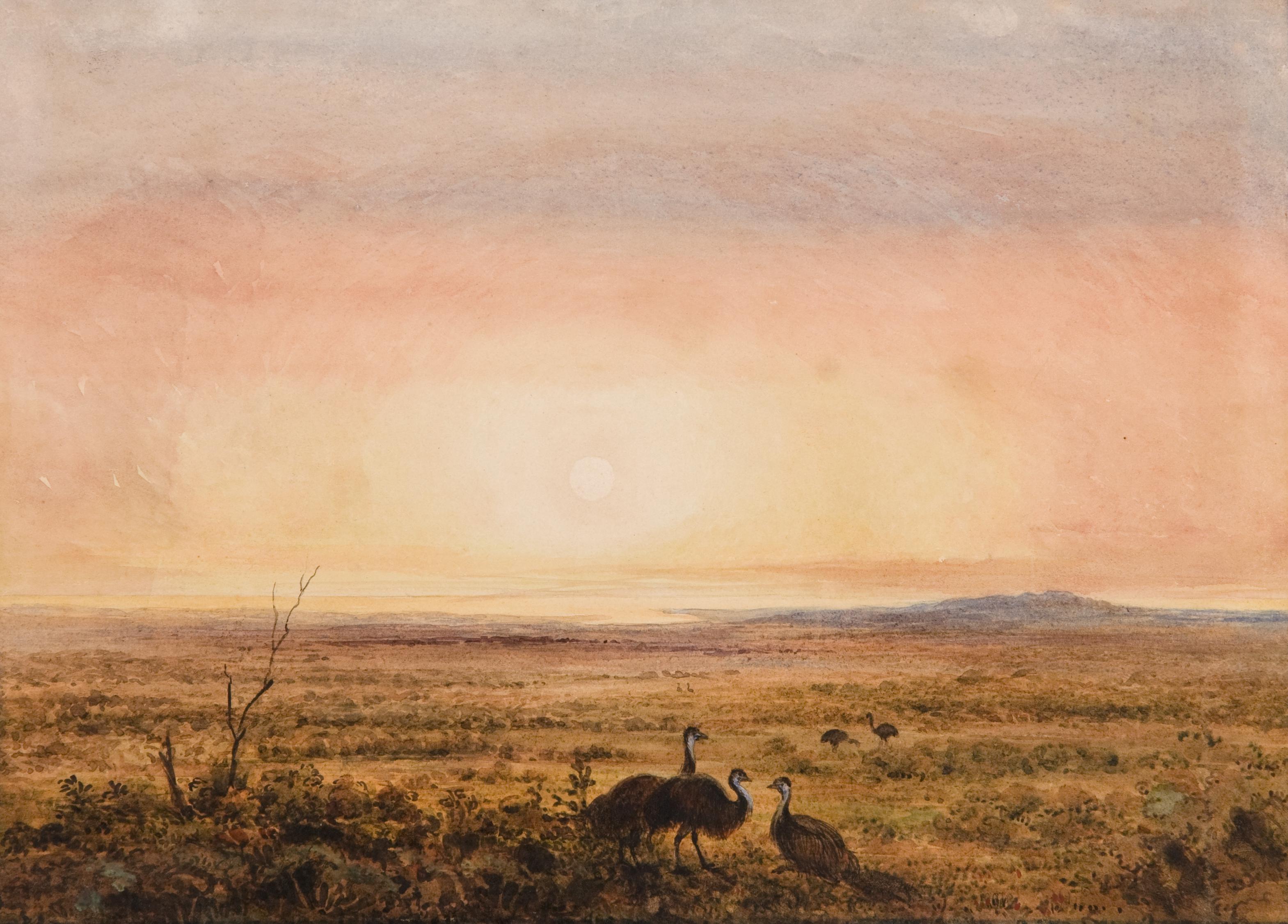 Scene showing emus in a plain (Coorong) | Art Gallery of South Australia 721HP4
Artist: Gill, S.T. (attr.) | Date: 1844-06~/1845-06~ | Appleyard cat. n/a | 23(H) x 32.5(W) cm
Catalogue: S.T. Gill and George French Angas, 1844-1845
This scene is not a standalone plate in "South Australia Illustrated" but was used in the composite image on the cover of each section.
A water body appears in the distance, emus in the foreground among low vegetation. The image is quite like Frome's "First view of the salt desert - called Lake Torrens" (AGSA 709HP15) but with emus added. That view is actually Lake Frome (which was known as Lake Torrens at the time).
This work may well correspond with Angas' London exhibition no. 186 "Lake Torrens, sunset during a 'sirocco'".
Jones (2021) says this watercolour "[by Angas] appears to be a combination of one of Angas's own watercolours of emus ... with [James] Henderson's mirage-like Lake Torrens shimmering in the distance through a dust storm." (105-107) The dust storm picture is presently attributed not to Henderson but to E.C. Frome in AGSA catalogue and Auhl & Marfleet, 1977 (89).
The sunset sky is similar to Gill's Horrocks picture, AGSA 0.1253. Foreground detail similar to AGSA 20114P25 (Mount Gambier) suggests Gill, not Angas, as the author of this work (albeit based on another work by Frome).
This unsigned picture is likely to have been painted by Gill for George French Angas. It has Angas/Johnson family provenance (Miss E M Johnson).
592
Aborigines and white men hunting kangaroos | National Library of Australia NK1196
Artist: Gill, S.T. | Date: 1844-06~/1845-06~ | Appleyard cat. n/a | 24(H) x 37.1(W) cm
Catalogue: S.T. Gill and George French Angas, 1844-1845
Aboriginal men and two colonists hunt kangaroos from scrub at the bottom of a hill running onto a broad grassy flat. One of the white men has a kangaroo dog; the other fires a gun.
This work may correspond to Angas' London exhibition no. 207 "Kangaroo hunting in the scrub, near Moorundi".
In April 1851 Angas had for sale in Melbourne a work titled "Kangaroo Shooting, South Australia" (Empire, 18 April 1851: 3 <http://nla.gov.au/nla.news-article60034199>).
These references, combined with the absence of a known Angas equivalent, suggest the London and Melbourne pictures were likely this unsigned work by Gill.
122
 Kangaroo hunting, Eyre Peninsula | Art Gallery of South Australia 20114P26
Artist: Gill, S.T. (attr.) | Date: 1845-05~/1846~ | Appleyard cat. n/a | 23.4(H) x 32.4(W) cm
Catalogue: S.T. Gill and George French Angas, 1844-1845
This work corresponds with Angas' London exhibition no. 202 "Kangaroo Hunting, country westward of Port Lincoln, with Albert's Peak in distance". This is also the watercolour for plate 19 in Angas's "South Australia Illustrated".
It appears based on a Port Lincoln landscape sketch NLA R6411 dated 7 May 1845.
This unsigned watercolour incorporates action in Gill's wash drawings such as NLA NK7063/15 or NLA R117 (for James Allen). The kangaroos here look just as unrealistic as those in the wash drawings and the number and positiion of riders, dogs and kangaroos are almost identical.
This would suggest one of three possibilities - that this watercolour may have been painted:
1. by Angas in London after Angas borrowed Gill's "Hunting the Kangaroo" (NLA R117) from Allen or the SA Company – around mid-1846;
2. by Angas in South Australia (using Gill's action figures); or
3. by Gill for Angas before he left South Australia in July 1845.
If painted in South Australia it was likely painted around May-June 1845 after Angas returned from Port Lincoln.
This may be one of the pictures Angas was selling in Melbourne in April 1851. [Provenance: Douglas and Barbara Mullins 2011.]
I think it is more likely by Gill than Angas.
546
The City of Adelaide from Mr. Wilson's Section on the Torrens, June 1845 | Art Gallery of South Australia 721HP1
Artist: Gill, S.T. (attr.) | Date: 1845-06~ | Appleyard cat. n/a | 24.5(H) x 32.8(W) cm
Catalogue: S.T. Gill and George French Angas, 1844-1845
On the reverse in pencil: "City of Adelaide – from Mr Wilson's selection – June 1845" (Tregenza, 1982, 34)
This watercolour is the original for plate 1 in Angas' "South Australia Illustrated" – "The City of Adelaide from the Torrens near the Reed Beds". A picture with this title was also shown in Angas' 1846 Egyptian Hall exhibition (no. 184).
A windmill is just prominent centre (with a reddish coloured tower) and a second one further to the right. These are likely the windmills on the western side of Adelaide (north to south): Phillips' mill (acre 186) corner Waymouth St and West Terrace; and City Mill on Wright Street (acre 464). Phillips' brick mill (readily recognised in other Gill paintings) had its sails disabled by lightning in February 1845 and by April was being fitted as a steam mill.
Through a gap in the trees (middle left) one glimpses buildings on North Terrace – seemingly Trinity Church with its tower, which was so iconically used in portrayals of the city from the northwest (Martha Berkeley, F.R. Nixon). However this detail is omitted from the plate by London lithographer J.W. Giles.
For more detail see the catalogue / main entry.
Map | S. T. Gill - Adelaide District
150
Blue Lake, Mount Gambier | Art Gallery of South Australia 20114P25
Artist: Gill, S.T. (attr.) | Date: 1844-06~/1845-06~ | Appleyard cat. n/a | 24.7(H) x 34(W) cm
Catalogue: S.T. Gill and George French Angas, 1844-1845
The scene is Mount Gambier and one of its volcanic lakes. The lake walls seem more steeply sloped than in the wash drawing. Birds fly across the lake and sit in a (sheoak?) tree. Rising smoke to the left of Mount Gambier likely suggests the presence of Aboriginal people.
George French Angas accompanied Governor Grey's expedition to S.E. South Australia in April-May 1844 and the party explored this place on 6 May 1844 noting the "numerous ducks" on the lake.
This watercolour was the basis for plate 17 of Angas' "South Australia Illustrated": "Mount Gambier, with one of its volcanic lakes (after sunset)". This work may be that in Angas' London exhibition no. 181 "Mount Gambier and one of its volcanic lakes".
This work is very similar to Gill's 1844/1845 wash drawing (NLA NK7073/6) but differs in a grander scale for the lake and larger and more numerous waterbirds. Note the similar three trees on the lake wall (left middle). The most straightforward explanation would be that this grander watercolour was developed from Gill's humbler picture (and not the other way round).
This watercolour is likely by Gill. The foreground vegetation detail is consistent with Gill's style. The sunset sky is also similar to Gill's Horrocks picture, AGSA 0.1253. It was most likely painted around May-June 1845 when Angas was in Adelaide finalising material for "South Australia Illustrated".
Just like NLA NK7073/6 this picture is probably intended to represent Blue Lake with its steep walls, but it is not topographically correct, and the view seems foreshortened (eliminating Valley Lake) for effect.
For more detail see the catalogue / main entry.
Map | S. T. Gill - South Australia
487
 North Terrace, Adelaide | Art Gallery of South Australia 0.628
Artist: Gill, S.T. | Date: 1845-06~ | Appleyard cat. n/a | 27.2(H) x 40(W) cm
Catalogue: S.T. Gill and George French Angas, 1844-1845
This is an almost identical view to AGSA 0.648 for James Allen (1845) and is the same size. In this version Gill seems to have (accidentally?) omitted the sloping front roof line of Trinity Church - something not apparent in other views.
The viewpoint is a little bit further west than 0.648 and shows at right acres 6 to 9. There are two bullock drays, one loaded with wool bales. The Mount Lofty ranges are the backdrop for the city. Of particular interest is that this scene includes the Black Swan (acre 7) with its street light. John Shand gained a beer and wine licence for this inn on 9 June 1845 and this helps us date the scene. See AGSA 0.648 for a description of more buildings in this picture.
The character at left, near two busy dogs, is likely intended as the artist himself, and there are no Aboriginal people apparent in this scene. This work shares these attributes with AGSA 0.648.
The work was a gift from Angas' brother, J H Angas, 1902. Signed (l.r.) G.F. Angas. Later caption on mount "[Sketch (struck out)] by George French Angas | North Terrace, Adelaide 1844". Angas' Adelaide exibition opened on 18 June 1845 and he left Adelaide on 2 July. Combined with the date of the Black Swan licence, this suggest Gill painted this in June, and, given the signature and provenance, he painted it for Angas.
It was originally attributed to Angas and appeared as such in the newspaper: Chronicle, 1 October 1931: 31. <http://nla.gov.au/nla.news-article90638698>.
Thanks to AGSA for catalogue notes and a high resolution scan of this work.
Map | S. T. Gill - Adelaide
776
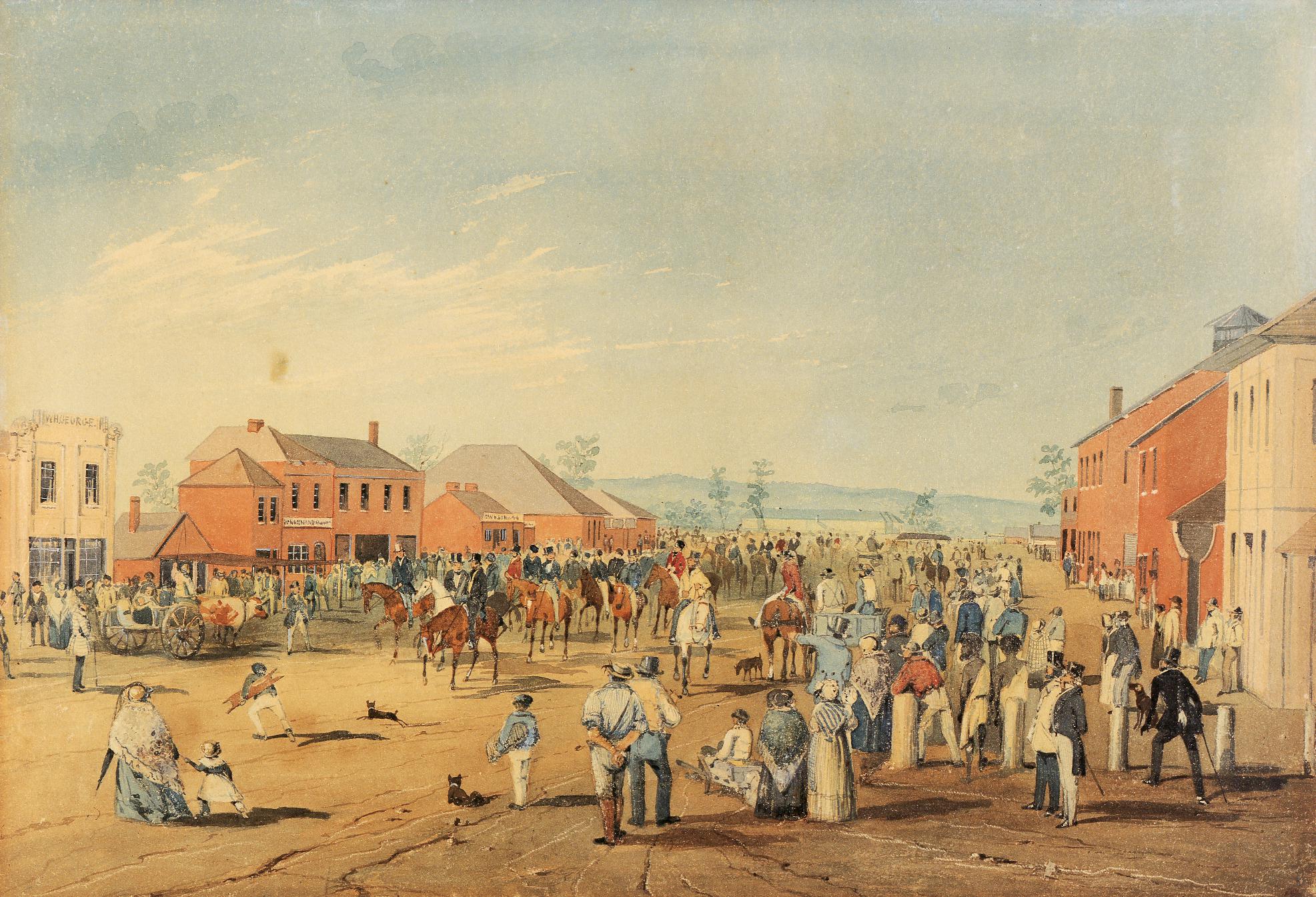 Sturt's Overland Expedition leaving Adelaide, August 10th, 1844 | Art Gallery of South Australia 0.644
Artist: Gill, S.T. | Date: 1845-06~/1845-11 | Appleyard cat. 81 | 27.2(H) x 40(W) cm
Catalogue: S.T. Gill and James Allen, 1845
The scene is the departure from Adelaide of Charles Sturt's Great Northern Expedition on 10 August 1844 ("head-on" view).
Charles Sturt and other dignitaries are at the head of the procession, with Sturt wearing top hat and tails and riding his well-known grey horse. The newspaper reported Major O'Halloran, Captain Sturt and Judge Cooper led. The view is south along King William Street from the intersection with Hindley Street (right foreground) and Rundle Street (out of picture) and includes street frontages in Adelaide acres 78 (right) and 79 and 108 (left).
The large red double storey building (signed, fourth from left) belonged to dentist surgeon Robert Norman and was built between April and July 1845. Also a building (right) shows William Younghusband's stores with its octagonal turret (completed around March 1845). Both buildings are anachronisms for Sturt's departure. So this was not Gill painting "on the spot" in August 1844.
Other buildings are from left: W.H. George plumber and glazier (white stone front), possibly C. Hussey, Robert Norman surgeon dentist, vacant land, Day and Sons blacksmiths, Montefiore merchant. Buildings at right likely include W. Richards tailor (opposite W.H. George).
This painting was used by George French Angas for plate 54 in his "South Australia Illustrated" and attributed to T.S. Gill. Although the painting could have been painted just in time for Angas' departure from Adelaide on 2 July 1845, there is strong provenance and other evidence for this being part of James Allen's commission. Allen left Adelaide for England in November 1845 and the painting was probably executed between July and November 1845. This implies Angas borrowed it from Allen or the South Australian Company when preparing the final installment of "South Australia Illustrated".
This picture is part of the James Allen commission. I think the character at left in the checked jacket, appearing in several pictures of the Allen commission, is likely James Allen.
For more detail see the catalogue / main entry.
Map | S. T. Gill - Adelaide
248
Port Adelaide, South Australia | National Library of Australia NK208
Artist: Gill, S.T. | Date: 1845-05~/1845-11 | Appleyard cat. n/a | 22.5(H) x 34.2(W) cm
Catalogue: S.T. Gill and James Allen, 1845
A view generally south-east across Gawler Reach / Hindmarsh Reach to Port Adelaide. The Mount Lofty Ranges are in the background. Prominent are the South Australian Company stores (McLaren warehouse, red building, left) and the Customs House (white building, centre). Between them are the flagstaff and the canal beside Queen's Wharf. On the river side of the Customs House are the Queen's wharf warehouses. At right is the confiscated French ship "Ville de Bordeaux". To the left of McLaren warehouse is a shed on McLaren wharf.
This is Gill's more favoured angle across the Reach showing the north and west sides of McLaren warehouse.
This is likely one of James Allen's "Two views of Port Adelaide in 1846". (Allen left Adelaide in November 1845, so "in 1846" is his equivalent of "as it now is".) "Mr Allen then described the port generally, and pointed out the situation of most of its buildings, with the names of their occupants or proprietors. This he afterwards more fully illustrated by two drawings of the port, one taken from its approach by water, and the other from the road leading from the port to town." (The South Australian News (London), July 1846: 50.)
For more detail see the catalogue / main entry.
Map | S. T. Gill - Port Adelaide
222
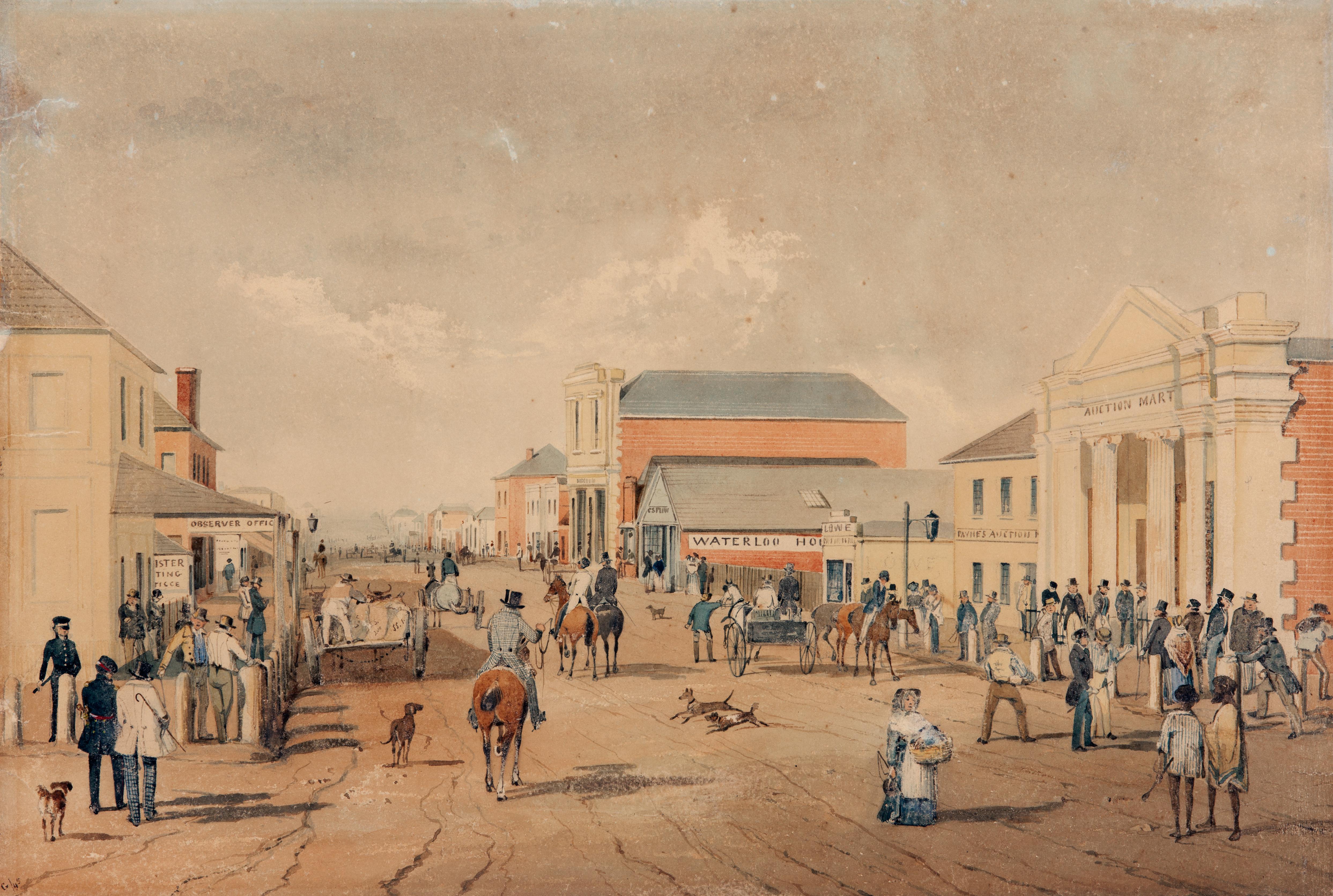 Hindley Street, Adelaide, looking west from King William Street | Art Gallery of South Australia 0.642
Artist: Gill, S.T. | Date: 1845-10~/1845-11 | Appleyard cat. 44 | 27.3(H) x 39.8(W) cm
Catalogue: S.T. Gill and James Allen, 1845
This is a view to the west along Hindley Street from its intersection with King William Street.
Building signs on the left (south) side leading away from the viewer are: Register Printing Office (... ister ... ting ... ficce) and Observer Office. On the right (north) side are: Auction Mart, Payne's Auction (Mart Tavern), Lowe (chemist), Waterloo House and C. S. Platts, with the next sign (illegible) being the two storey whitestone fronted brick building of Robert Sanders, draper. Platts was at Waterloo House (acre 48) to April 1844 after which the building was occupied by John Stephens who also moved his Observer newspaper office there. The building at near left was a store formerly occupied by Murray and Greig and also Stocks. After buying James Allen's SA Register, John Stephens consolidated the Register and Observer and General Printing Office in this building from 20 September 1845. The Auction Mart at right is at it appeared after the whitestone front was added in December 1844 and before the eastern collonade was added in December 1845. We can thus date this scene around October / November 1845.
The name "C.S. Platts" on Waterloo House is likely an anachronistic nod to the manner in which Stephens supplanted Platts' business in which he allowed the Platts name to be associated with his identical business.
The parked bullock dray at left of picture contains sacks with unclear labels, seemingly reading SG, STG 200 and SG 1. This seems to be a reference to James Allen's commission - see also AGSA 0.647. This picture is part of the James Allen commission. I think the character at left in the checked jacket, appearing in several pictures of the Allen commission, is likely James Allen. The Aboriginal man right foreground is draped in a government issue blue striped blanket.
For more detail see the catalogue / main entry.
Map | S. T. Gill - Adelaide
16
Forest Creek, Mount Alexander, from Adelaide Hill | National Library of Australia PIC SolanderBoxA16 R6541
Artist: Gill, S.T. (attr.) | Date: 1852-09~ | Appleyard cat. n/a | 25(H) x 35.2(W) cm
Catalogue: George French Angas - Victorian Diggings, 1852
Pencil sketch for lithograph of the same name. In the pencil sketch (NLA R6541) and lithograph (NLA NK6288/B), the built structures and landscape are the same but the Angas lithograph adds all the foreground characters and shifts the puddling barrel back to accomodate a second cradle and pan. Note the detail of washing on the line which is a device used by Gill.
Due to the absence of foreground characters, the pencil sketch seems the basis for the corresponding lithograph, rather than the other way round as a tracing. Provenance: the (Angas family) Jose Calvo Collection.
I think this sketch is less likely to be by Angas and more likely to be by Gill (or maybe even by Gilfillan who joined Customs in June).
Map | S. T. Gill - Victorian Diggings
801
The Commissioners camp, at junction of Barkers & Forest Creeks, Mt. Alexander diggings, July 1852 | National Library of Australia PIC SolanderBoxA16 R6540
Artist: Gill, S.T. (attr.) | Date: 1852-06~/1852-09~ | Appleyard cat. n/a | 25(H) x 35.3(W) cm
Catalogue: George French Angas - Victorian Diggings, 1852
A broad landscape of the Forest Creek diggings featuring the Gold Commissioner's camp (left middleground).. Gill's field sketch "Portion Commissioners Camp F[orest] Creek" (SLV SLV H4589) covers the tented part of the camp to the right of the buildings.
Annotations include: "The Miners Store"; "wooden houses of Commissioners"; "military tents"; "suppy figures & some on horseback, mounted police &c"; "people washing pans & cradling on edge of creek"; "blue smoke"; "hazy"; "union jack"; "colour flags"; "butchers"; "holes & heaps of red & yellow earth"; "bridge"; "bark hut"; "grass"; "running stream" and colour instructions. (No cradle is drawn.)
The original title (l.l.) appears to have been "Commissioner [Camp?] / [Barkers &?] Forest Creek / June 1852". This has been overwritten to "The Commissioners camp, at junction of Barkers & Forest Creeks, Mt. Alexander diggings, July 1852". A later incorrectly dated inscription "George French Angas 1842" has also been added (l.c), but presumably not by the artist. Provenance: the (Angas family) Jose Calvo Collection.
Angas sent a sketch matching this description to London publisher Hogarth with a letter dated 11 October 1852 (Tregenza 22). With its marked directions for colours, and so it could "easily be understood without", i.e., in England, this is very likely the same view as the Hogarth letter.
The reverse has Angas's staffage for the lithograph "Forest Creek, Mount Alexander, from Adelaide Hill", namely: the digger cradling (rough and final versions) and the digger smoking.
The detail has the feel of an artist "on the spot", observing and capturing the landscape in detail. It may also be a composition from field sketches such as "Portion Commissioners Camp F[orest] Creek" (SLV H4589).
I think this June image is less likely to be by Angas and more likely to be by Gill (or maybe even by Gilfillan who joined Customs in June).
Map | S. T. Gill - Victorian Diggings
755
David Coombe. Original 13 February 2026. Updated 17 March 2026 (& work title). | text copyright (except where indicated).
CITE THIS: David Coombe, 2026, S.T. Gill as artist for George French Angas, accessed dd mmm yyyy, <https://coombe.id.au/S_T_Gill/S_T_Gill_artist_for_George_French_Angas.htm>